
FGTI-Distribution > Sealing Gaskets > Function of a Composite Gasket
| Function of a composite joint |

|
|
| Construction principle |
Composite seals are usually made up of two elements. The seal ring is machined from a filled PTFE, which is particularly resistant to wear. Thanks to the qualities of this material, the seals can withstand pressure, speed and resist significant temperature variations. 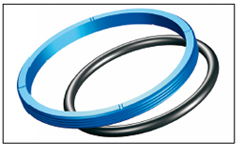
|
Inasmuch as maximum values are only reached by the addition of different parameters, preliminary tests are necessary in certain extreme applications. An elastic prestressing element provides the necessary pressure to ensure sealing between the friction surface and the opposing surface, thereby guaranteeing the longevity of the seal. The prestress is applied by an elastomer O-ring or a profiled steel spring. O-rings also provide static sealing at the groove bottom. When selecting the materials for the sealing ring and the prestressing element, operating conditions must be taken into account. |
| Internal or external waterproofing |
All seals providing radial sealing can be designed to ensure either internal or external sealing.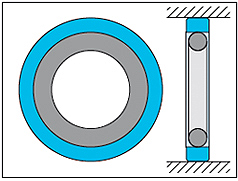 Exterior sealing, for example MANOY® piston seal profile 112 Exterior sealing, for example MANOY® piston seal profile 112
|
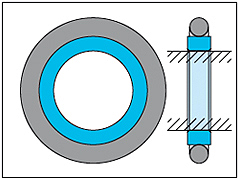 Internal sealing, for example for a MANOY® stem seal, profile 120
|
| How waterproofing works |
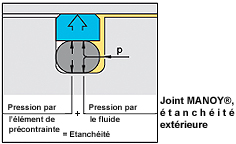 MANOY composite seals and lip seals are activated by fluid pressure. Through the elasticity of its gland profile, the O-ring ensures static sealing in the gland profile and pushes the dynamic seal onto the opposing surface. MANOY composite seals and lip seals are activated by fluid pressure. Through the elasticity of its gland profile, the O-ring ensures static sealing in the gland profile and pushes the dynamic seal onto the opposing surface.
|
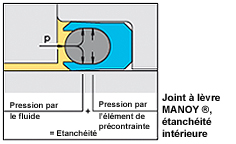 The fluid pressure exerts additional pre-stress on the piston seal.
Thus, the pressure required to ensure sealing is balanced by the pressure supplied by the fluid.
Up to approximately 2MPa, the sealing force is achieved almost solely thanks to the thrust of the pre-stressing element.
The fluid pressure exerts additional pre-stress on the piston seal.
Thus, the pressure required to ensure sealing is balanced by the pressure supplied by the fluid.
Up to approximately 2MPa, the sealing force is achieved almost solely thanks to the thrust of the pre-stressing element.
|
| Profile selection |
|
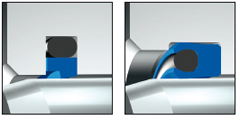
The choice of seal ring profile essentially depends on the movement, direction, and pressure value, as well as the fluid quality. |
| O-ring pre-tightening |
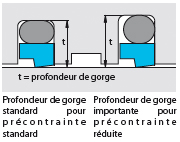
In order to ensure a good seal, the housings are positioned so that an average prestress is exerted by the O-ring or by the spring. A shallower groove depth ensures greater pre-stressing and thus improves sealing at low (up to approximately 2MPa) or non-existent pressures. A deeper groove depth allows for some operational flexibility which will, however, be at the expense of sealing. |
|
| Operating game value |
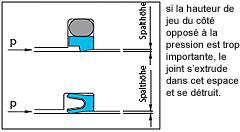
The minimum required play depends on the guidance accuracy and other mounting parameters. Therefore, potential increases in pressure and thermal expansion must be taken into account. On the opposite side to the pressure, weak plays should be favoured, whereas on the pressure side, a high play helps to avoid particle build-up. For pressures exceeding 40 MPa, adherence to H8/f8 tolerance values for bore/piston and liner/rod diameters is imperative. |
|
| Waterproofing | A seal can only be perfectly leak-tight if it is static. When in motion, sealing is more difficult. Completely dry operation would lead to wear of all sealing elements. In dynamic sealing, light lubrication by the fluid on the opposing surface will ensure proper functioning of the seal. | |

Technical parts and high-value-added services
FGTI Distribution © 2024 All rights reserved
Legal information
Quality Policy
Terms and Conditions of Sale
Website by AroConseil